
As a tech person, I should be all over IoT, yet I’m not. Whenever I look at the options, I can admit that they are cool, but I struggle to find the use case.
Here are my main issues with IoT today:
No Real Standard
There are many different IoT devices out there. Some of them play nice together, many of them don’t.
In my opinion, for IoT to really take off, there needs to be a unifying standard. Much like SmartWatches, IoT devices should not be dictating the system I have to use. I should be able to choose the system I want (e.g. Smart Things or HomeKit), and devices should just fit into that.
Manufacturers need to agree on some standards, and not expect consumers to have to live with many different systems. In the end, IoT really needs to become a lot like Bluetooth.
One App To Rule them All
Related to the above, I don’t want to have to use a different app for each of my IoT systems: I want to just be able to have one app to control them all.
Not only does this make things easy to manage, but it allows much more complex setup. You can have all your IoT devices linked together in complex and seemingly magical ways.
There are inroads being made here, of course. Smart Things aims to tie several disparate systems together, and allow control and programming from a single app. It even ties in with the likes of Amazon Echo to enable voice control.
Similarly, HomeKit from apple is attempting to tie these systems together to allow voice control via Siri. You still need the app for each system, though. And if you want to do it manually, then you have to work in each app itself. There are rumours that apple is working on an app in iOS 10 that will allow these things to tie together – but it’s going to need to stop me needing to install those other apps in the first place. I only want to install one app, and have it control them all.
Current Functionality First
IoT needs, first and foremost, to not get in the way of everyday life. Take smartbulbs for example.
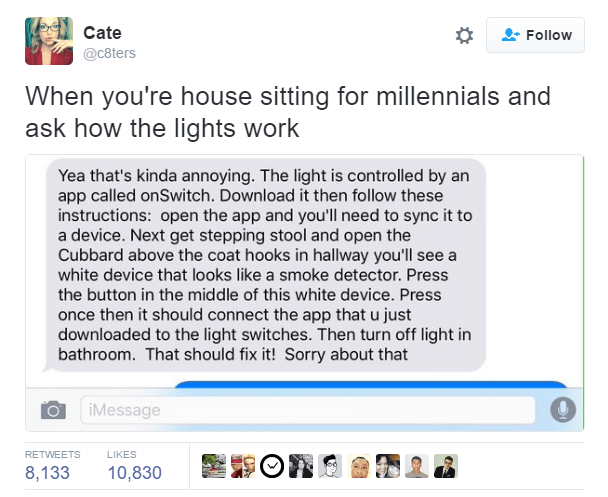
With a smartbulb, you need to ensure that the power is permanently on to the bulb, in order to control it via an app. This is all well and good, but becomes a nightmare when Someone is visiting.
Some bulbs (such as Lifx) apparently will automatically switch on like a normal bulb if you power-cycle them.
But even that is a minor pain. Now, to use my bulb without the app, I need to turn the light off and back on again.
How do you explain to your Granny that whenever she comes into the house she needs an app to unlock the door, turn on the lights, etc? Do you want to try to explain what an app is? How to pair it with your house? Or that she has to just flick the lights on and off a couple of times (but not too often, or you will reset the system!)
IoT needs to adopt an approach where they aim to deliver current functionality seamlessly, and provide a magical world of enhancement on top of that for those users.
Easily Reversible
A lot of IoT already does this, to be fair, but in most cases IoT needs to be easily reversible. Many people around the world rent their properties. They need to be able to install and use their IoT devices in a manner that allows easy reversal once they move out. Requiring rewiring, or holes in the plasterboard are out.
Solve Genuine Needs
Again, this can be hit and miss on some current devices. Do I really need a toaster that will send me a notification when it starts to burn? Probably not.
Secure and Reliable
Smart locks seem like a cool idea: When you come home, your door will unlock automatically. You can let someone in remotely, or provide schedules that they are permitted to unlock the door. You can even get notifications when that troublesome teen tries to sneak in at 03:00.
But can you trust an internet connected device to secure your home? Can you trust that it’s actually locked? What if there’s a glitch?
To “hack” a mechanical lock requires skills at lockpicking (or at least an Enforcer) to get in. With IoT locks, it only takes one person to find the magic touch, and it can be in the handle of thousands of Script Kiddies within hours. Is it likely? Maybe not. But do you want to take that chance?
Other IoT devices are the same. You need to be sure that whilst you can access your devices (locally and remotely) with ease, other people cannot.
Conclusion
It’s hard for me to find the use case for IoT in life at the moment. But that doesn’t mean I’m going to stop trying. A colleague is going to lend me some Lifx bulbs, so I’ll spend some time trying those out, and see if I can fall in love with them.
 Kept in Tech